Behind the Scenes
How Silicone Kitchen Tools Are Actually Made
From raw polymer to your utensil crock: compounding, steel cores, post-curing and the invisible corners cheap tools cut, plus the five-second store tests that expose them.

"Food-grade silicone" appears on roughly every silicone product sold, which should make you suspicious. A phrase that everything claims is a phrase that means nothing by itself. Underneath the label, though, there's a real standard with real chemistry, real tests, and a real difference between silicone you'd want stirring your dinner and silicone you wouldn't. This is the plain-English version: what the term legally means, how genuine food-grade differs from the impostors, what the science says about safety, and how to check what's actually in your own drawer.
In the US, food-contact silicone falls under FDA regulation 21 CFR 177.2600: the rulebook for rubber articles intended for repeated food contact. To comply, a material has to be made from permitted ingredients and pass extraction testing: samples are soaked in food-simulating liquids (watery, acidic, fatty) and the amount of material that migrates out is measured against strict limits. Europe's LFGB standard runs the same idea with even tighter thresholds.
So the term does mean something: when the testing behind it was actually done. The catch is that printing "food-grade" on a box costs nothing, and no inspector checks a $9 marketplace spatula. The label is a claim; the batch test is the fact. That's why our production runs are extraction-tested per batch rather than once for a framed certificate — a distinction we covered from the factory side in how our tools are made.
Silicone's safety case rests on its chemistry being boring. The silicon–oxygen backbone is one of the most stable bonds in materials science: the same family as glass and quartz. Practical consequences for a cooking tool:
It's inert across kitchen conditions. Acidic tomato sauce, alkaline dough, salt, oil, −22°F freezers and 446°F pans all leave it chemically unbothered. There's no reactive surface to corrode, leach or off-gas within that range.
It contains no plasticizers. The additives that made plastics infamous, BPA, phthalates, exist to soften rigid plastics. Silicone is intrinsically flexible; it doesn't need them, so properly made silicone doesn't contain them. "BPA-free" on a silicone product is technically redundant, but we print it because shoppers deserve the reassurance without a chemistry lecture.
It doesn't host bacteria the way scratched plastic does. A non-porous surface with no micro-cracks gives biofilms nowhere to anchor: one reason silicone replaced rubber in medical tubing decades before it conquered kitchens.
The entire safety argument is that silicone is chemically dull. Every scary story about it involves material that wasn't really, or wasn't only, silicone.
The economics are simple: silicone gum is expensive, mineral filler is nearly free, and a blended head looks identical on a shelf. Filler-stretched silicone is where the horror stories live. It's weaker (cracks at flex points), less heat-stable (softens and smells at oven temperatures), and its migration behavior is whatever the mystery filler decides.
| Check | Pure food-grade silicone | Filler-blended |
|---|---|---|
| Pinch-twist test | Returns to color, no marks | Whitens along the stress line |
| Smell when new | None | Rubbery / chemical, fades slowly |
| First hot use | No odor, no taste transfer | Faint smell, sometimes taste |
| Flex points after months | Intact | Micro-cracks, then splits |
| Surface after tomato/curry | Wipes clean | Staining that won't lift |
The pinch-twist check costs five seconds in any store: fold a corner of the silicone hard and watch the crease. Whitening means filler particles pulling away from the polymer: the material equivalent of an admission. Every head across our utensil range passes it, because the compound is silicone all the way through.
Our tools are rated −22°F to 446°F (−30°C to 230°C), and those numbers describe the range where the material stays fully itself, flexible, inert, odorless. Everyday cooking lives comfortably inside it: frying pans run 350–400°F, oven bakes rarely pass 450°F at the surface a tool briefly touches, and freezer storage sits at 0°F. What the rating does not cover is direct contact with flames or bare heating elements, which reach 1,000°F+: no kitchen polymer survives that, and no honest brand claims otherwise. Resting a spatula head on a lit burner is the one way to actually damage food-grade silicone, and it's user error, not material failure.
At the other extreme, silicone stays flexible at deep-freeze temperatures where plastics turn brittle and shatter — why it took over ice trays and freezer molds. One material family, both ends of the kitchen's thermometer.
Silicone asks almost nothing, but three habits keep a tool as clean as the day it passed its batch test. Wash before first use. Not for safety, but to clear packaging dust. Skip harsh solvents; hot water and dish soap clean a non-porous surface completely, and there's nothing a stronger chemical could improve. Retire a tool that's actually damaged: a deep cut from a knife edge creates the crevice the intact surface never had. With steel-cored construction that's a rare event; the core prevents the flexing that opens cheap tools up. Full routines per material live in our care guide.
Product listings in this category wear badges like a general wears medals, and they are not all the same rank. A translation guide for the ones you'll actually meet:
FDA 21 CFR 177.2600 is the US food-contact rulebook described above: the meaningful baseline. Note the phrasing trap: "FDA compliant" claims the material meets the standard; "FDA approved" is technically wrong (the FDA doesn't pre-approve kitchen tools), and a listing that says it is telling you something about its copywriting rigor. LFGB is Germany's standard and the strictest common one. Its sensory test literally includes whether the material transfers taste. Hence "LFGB tested" is the badge worth the most respect on a silicone listing. "SGS tested" names a laboratory, not a standard: SGS is a legitimate testing giant, but the badge is meaningless without saying which test was passed, like citing "measured with a ruler" as a dimension. And "BPA-free", as covered earlier, is true of all real silicone; on an honest product it's reassurance, on a filler-blend it's misdirection.
| Badge | What it actually certifies | Weight to give it |
|---|---|---|
| FDA 21 CFR 177.2600 | Material meets US food-contact limits | The baseline, expect it |
| LFGB | Passes Germany's stricter migration + sensory tests | The strongest common badge |
| "SGS tested" | A lab was involved; test unspecified | Zero, without the standard named |
| "BPA-free" | True of all genuine silicone | Fine, but not evidence by itself |
| "Food-grade" (bare) | Nothing verifiable on its own | A claim, pending the badges above |
"Silicone leaches when heated." Genuine food-grade silicone within its rated range doesn't — that's precisely what migration testing measures and what passing it means. The stories behind this myth trace back to filler-blends and to bakeware pushed past its rating, both real phenomena and both not-silicone problems.
"The white residue after washing means it's breaking down." That chalky film is almost always hard-water minerals or detergent buildup sitting on the surface: the same film that appears on glasses. A vinegar rinse removes it. Actual silicone degradation looks like cracking and tackiness, not powder.
"Silicone absorbs flavors permanently." Surface oils can cling stubbornly, garlic and chili are the repeat offenders — but absorption into the material isn't happening; the surface is non-porous. The 250°F oven trick from the care section above clears what soap misses, every time.
"Darker colors hide worse material." No correlation. Pigment choice is aesthetic; material grade is a compounding decision made before any color exists. Judge by the pinch-twist and the badges, not the shade — our own black and khaki heads come off the identical compound line.
"If it smells at the store, it'll air out." It will, mostly, but the smell was information. Fully post-cured silicone never had it. A tool that needed to air out is a tool whose factory skipped a step you can't verify they didn't skip elsewhere.
Is silicone "eco-friendly"? The honest answer is more interesting than the marketing one. Silicone is not biodegradable, and curbside recycling doesn't take it: anyone selling it as a green miracle is overreaching. Its genuine environmental case rests on two different legs.
Durability is the argument. The environmental cost of a kitchen tool is mostly how often it's replaced. A nylon turner that melts in year one and a filler-blend spatula that cracks in year two are recurring purchases with recurring footprints; a steel-cored silicone tool doing the same job for eight years amortizes its manufacture across every one of them. In kitchenware, longevity beats material pedigree almost every time. The greenest tool is the one you never re-buy.
Stability is the other leg. Unlike degrading plastics, silicone doesn't shed microplastic-style fragments as it ages. The same inertness that protects your food keeps it from crumbling into the environment during its working life. And at end of life, an intact silicone tool has an unusually long second act: the material's tolerance for heat and cold makes retired spatulas genuinely useful as garage scrapers, paint tools and plant-pot levelers for years after kitchen retirement.
So the honest framing: silicone is not a compostable material, it's a durable one, and in a category drowning in yearly-replacement tools, durability is the environmental feature that actually moves the needle. Buy once, use for a decade, demote to the garage. That lifecycle beats most "eco" labels on the shelf.
Questions about silicone sharpen when the kitchen serves babies, allergy-prone eaters or anyone managing chemical sensitivities: reasonably so, since these are the diners least able to shrug off a materials mistake. The good news is that the standards above were written with exactly this population in mind: the FDA extraction limits and LFGB sensory tests assume daily, repeated contact, not occasional use. For these households the practical advice concentrates, rather than changes: insist on the named standards instead of bare "food-grade," run the pinch-twist and smell checks on arrival rather than eventually, wash before first use without exception, and retire tools at the first sign of surface damage rather than the fifth. Silicone's track record in baby bottle nipples and pacifiers, categories with the strictest scrutiny in consumer products, is the strongest real-world evidence the material has: it earned the most demanding food-contact job in the house decades before it earned the spatula drawer. If a materials standard is trusted enough for a newborn's daily routine under pediatric-grade scrutiny, a spatula stirring Tuesday's soup is comfortably inside its safety margin: provided, as always, that the material really is what the label claims, which is the entire reason the checks in this article exist.
Take your current silicone tools and run the battery: pinch-twist for whitening, sniff for chemical smell, look for cracks at the neck and flex points, check for stains that won't wash out, and recall whether anything ever transferred a taste. Tools that fail aren't poison, but they are telling you what they're made of, and they'll keep failing harder with heat and time. Tools that pass are genuinely inert kitchen companions for years.
If the audit retires a few impostors, replacing them with one honest standard is exactly what a set is for: the sizing guide finds the right one in four questions, and every candidate carries the numbers this article just decoded: food-grade, BPA-free, −22°F to 446°F, steel-cored, batch-tested. That's the whole vocabulary, and now it's yours: take it to any shelf, any listing, any drawer.
From raw polymer to your utensil crock: compounding, steel cores, post-curing and the invisible corners cheap tools cut, plus the five-second store tests that expose them.
No seasoning, soap is fine, and only one real enemy: the complete care manual for a dutch oven that should outlive its warranty by decades.
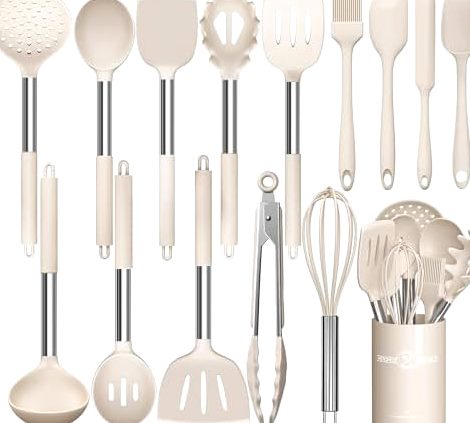
Every set size claims to be the right one. It can’t be. What each tier actually contains, who genuinely needs it, and four questions that pick your box in a minute.