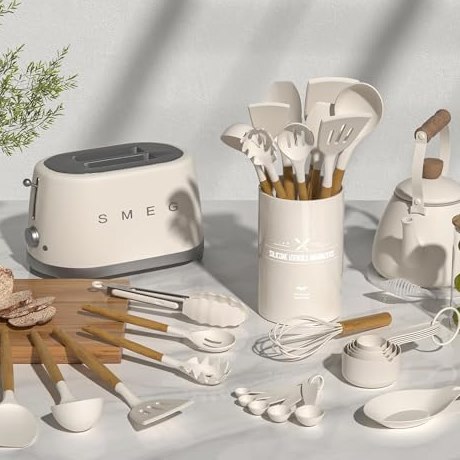
Behind the Scenes
How Silicone Kitchen Tools Are Actually Made
From raw polymer to your utensil crock: compounding, steel cores, post-curing and the invisible corners cheap tools cut, plus the five-second store tests that expose them.

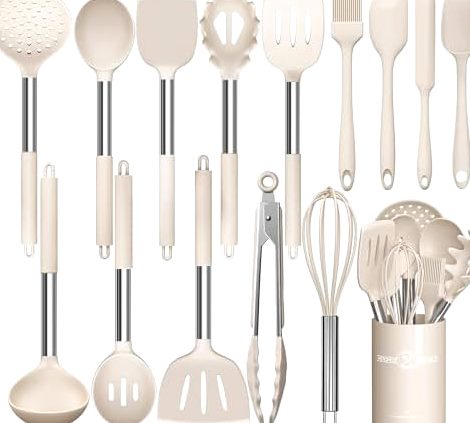
Utensil sets come in sizes from eight pieces to forty-three, and the marketing for every one of them implies it's the right choice. It can't be: an eight-piece set and a forty-three-piece set solve different problems for different kitchens. After watching tens of thousands of buyers pick (and occasionally re-pick), here's the honest sizing guide: what each tier actually contains, who genuinely needs it, and the questions that route you to the right box the first time.
The instinct is to ask "how many tools do I need?" The better question is "what does my kitchen do on a normal Tuesday?" A person who cooks pasta twice a week and reheats leftovers uses perhaps six tools all month. A family kitchen running two meals a day touches twenty. A household that bakes, grills and meal-preps will genuinely rotate through thirty-plus. Buying above your tier means a crock of untouched handles; buying below it means the one tool you need is always dirty.
There's also a real argument for sets over singles that has nothing to do with count: a set is one material standard, one heat rating, one color across every tool you own. The mismatched-drawer look, and the mystery spatula that melts because it came from somewhere else, is what sets exist to end.
The 8-piece acacia set ($27.99) is the answer for minimalist kitchens, first apartments, and anyone who cooks simply but daily: ladle, serving spoons, slotted and solid turners, spoon spatula, angled spatula. Every piece earns its slot; nothing waits in the crock for a task that never comes. The acacia handles are the aesthetic pick of our whole range — this is the set that lives in a crock on the counter because it looks like it should.
Its honest limit: the moment you bake, whisk, strain or tong anything, you're borrowing from outside the set. Eight pieces covers cooking, not kitchens.
The 15-piece stainless set ($26.99) is our bestselling size for a reason: it adds the second ring of daily tools, whisk, tongs, pasta server, skimmer, basting essentials, while staying small enough that everything still gets used. With 18/8 steel handles it's also the fully dishwasher-safe tier, which quietly matters more than any tool count for households where cleanup is negotiated nightly. Eight colorways mean it matches whatever kitchen it lands in.
If you're unsure between two sizes, the 15-piece is the statistical safe pick: big enough for a family kitchen's Tuesday, small enough that nothing gathers dust.
This is the tier where a set stops being "utensils" and becomes the kitchen's whole toolkit. The classic 33-piece set with holder ($19.99, our most-reviewed product at 30k+ ratings) covers everything the 15-piece does plus measuring cups and spoons, oil brush, multiple spatula profiles, and the organizer holder that keeps thirty-three tools from becoming drawer sediment. The 34-piece grater set ($35.97) trades a few duplicates for a box grater and garlic crusher; the 34-piece thickened set ($35.99) is the same coverage in the heaviest-duty silicone we make, for cooks who bend lesser tools on fried rice.
Who this tier is actually for: families cooking daily, anyone furnishing a kitchen from zero (the per-tool math beats buying separates by multiples), and the wedding/housewarming gift that gets used instead of stored.
The 43-piece set ($36.09) exists for the from-scratch scenario: first home, post-move restock, a rental property, a beach house. It's the 33-piece coverage plus a full measuring suite and the doubles that busy kitchens actually consume, because when one turner is in the dishwasher, the second one is dinner. If your kitchen already works and you're upgrading materials, this is more set than you need; if you're starting from an empty drawer, it's cheaper than assembling half of it piecemeal.
| Set | Pieces | Best for | Handle / care | Price |
|---|---|---|---|---|
| Essentials | 8 | Minimalists, simple daily cooking | Acacia · handwash | $27.99 |
| Everyday | 15 | Most kitchens; the safe default | 18/8 steel · dishwasher | $26.99 |
| Full kitchen | 33 + holder | Families, from-zero setups, gifts | Anti-scald wood · handwash | $19.99 |
| Full + prep | 34 | Cooks who grate, crush, measure | Steel · easy handwash | $35.97 |
| Outfitting | 43 + holder | Empty-drawer starts, rentals | 304 steel · dishwasher | $36.09 |
1. Who washes up: machine or hands? Dishwasher households should stay on steel handles (15 or 43); wood handles want thirty seconds of hand-washing.
2. Do you measure and bake? If cups and spoons are part of your week, start at 33, buying them separately erases the smaller set's savings.
3. Is this replacing tools or starting a kitchen? Replacement kitchens rarely need past 15; empty drawers justify 33–43 on arithmetic alone.
4. Does the holder matter? If counter organization is half the reason you're shopping, the holder tiers (33 and 43) are the ones that ship with a home for every handle.
Piece counts hide as much as they reveal. A "34-piece set" where ten pieces are measuring spoons is a different purchase than one where ten are cooking tools. So here's the composition logic across our tiers, in plain terms. The 8-piece is all primary tools: things that touch the pan. The 15-piece keeps that ratio: roughly twelve pan-and-pot tools plus the serving layer. At 33 pieces, the census changes: about twenty are working tools, five are measuring cups, four are measuring spoons, and the rest are the oil brush, tongs and the holder. Hence this tier bakes and meal-preps, not just cooks. The 34-piece grater set swaps duplicates for the grater body and its three snap-in blades plus the garlic crusher, prep hardware, not filler. And the 43-piece adds the doubles on the highest-rotation tools: second turner, second big spoon, extra spatulas — the pieces that live in the dishwasher half the week in a busy house.
The takeaway when cross-shopping anyone's sets, including ours: count the tools that touch food in a pan, then the measuring suite, then everything else. If category three is padding the number, the "value" is arithmetic, not equipment.
Utensil sets are one of the great default gifts, wedding registries, housewarmings, first apartments, which means they're often bought for kitchens the buyer has never cooked in. The four questions still work; you just answer them from evidence. Newlyweds and registries: the 33-piece with holder is the classic for a reason: complete enough to anchor a kitchen, and the holder makes it look like a gift rather than a utility purchase. College and first apartment: the 43-piece, unsentimentally: it's an outfitting problem, and doubles matter when the dishwasher is a sink. The person who already cooks well: resist upgrading their count; upgrade their material instead with the 34-piece thickened set, which reads as "I noticed you actually cook" in a way sheer quantity never does. The minimalist or the design-conscious: the 8-piece acacia, full stop: it's the one tier bought as much for the counter as the cooking.
And the universal gift insurance: match the colorway to their kitchen if you've seen it, or default to black. The only finish that has never once appeared in a "beautiful but clashes with everything" review.
Some of the most satisfied kitchens we hear from didn't pick one tier. They run two sets with different jobs. The pattern is consistent enough to deserve a name. Main + overflow: a 15-piece steel set carries the daily load through the dishwasher, while an 8-piece acacia set lives in the counter crock for the pretty, low-abuse work — serving, stirring, the tools guests see. Two materials, two care routines, zero conflict, and both sets in the same colorway so the kitchen still reads as one decision.
The second pattern is home + elsewhere: the full 33-piece at home, and a 43-piece box shipped straight to the cabin, the rental property or the RV: places where "I'll just bring tools" fails every single trip, and where a set that includes its own measuring suite means never discovering at 8pm that the nearest teaspoon is forty minutes away. At outfitting-tier prices, duplicating a whole kitchen costs less than one good chef's knife.
Neither strategy shows up in marketing because "buy two sets" sounds like a sales pitch. It isn't: it's a materials decision (steel for the machine, wood for the counter) and a logistics decision (tools where the cooking happens), and the sizing logic of this guide applies to each set independently.
Read a few thousand utensil-set reviews and the regrets cluster with remarkable discipline. All three are avoidable in the moment of ordering.
Buying for the imagined kitchen. The 4-star review that says "beautiful set, honestly only use half of it" is aspiration tax in writing. The reviewer bought for the version of themselves who meal-preps Sundays and bakes bread; the actual Tuesday needed fifteen tools. The fix is the first section of this guide: size for the kitchen you run, not the one you're planning to become. Upgrading later costs nothing — our tiers share colorways precisely so a 15 can grow into a 33 without a mismatched drawer.
Ignoring the wash question. "Didn't realize the wooden handles need hand washing" is the most preventable one-star sentence in the category. It's on every product page, but nobody reads care lines in a buying mood. Machine households: steel handles. It really is that binary, and it outranks tool count in day-to-day satisfaction.
Treating color as an afterthought. The quiet regret: ordering default black, then noticing the khaki set would have matched the mixing bowls already on the shelf. Coordination is the cheapest upgrade in the entire kitchen — it costs zero dollars at order time and can't be patched afterward without re-buying. Thirty seconds on the Shop-by-Color pages before checkout is the whole insurance policy.
Almost no one regrets the quality tier they chose. The regrets are wash logistics, color, and buying for an imaginary Tuesday.
Storage sounds like an afterthought until thirty-three handles are competing for it. The included holder on the 33- and 43-piece tiers is a rotating carousel that keeps every tool visible and one reach away: the difference between using all your tools and using the four on top of the drawer pile. Counter crocks suit the 8- and 15-piece tiers, where the census is small enough to browse at a glance; wooden handles in particular earn their counter placement, since air-drying between uses is exactly what the material wants. Drawers work for overflow and doubles, with one rule: measuring sets live together on a ring or clip, because a drawer that eats the quarter-teaspoon does it forever. However you split it, the storage plan is worth deciding before the box arrives: sets get used in proportion to how visible they are, and the holder tiers are popular for precisely that reason. Out of sight, out of rotation is the quiet law of every kitchen drawer, and the carousel repeals it.
Sets are sized for kitchens, not for ambition. Buy the tier your Tuesday actually uses, in the material your cleanup style supports, in the color your kitchen already speaks, and every tool in the crock earns its place. Cross-shop the whole range side by side in the utensil collection, and if you want to know what's inside those silicone heads before you commit, the factory story is the next read.
From raw polymer to your utensil crock: compounding, steel cores, post-curing and the invisible corners cheap tools cut, plus the five-second store tests that expose them.
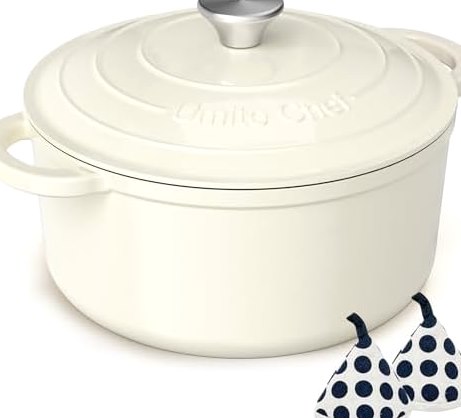
No seasoning, soap is fine, and only one real enemy: the complete care manual for a dutch oven that should outlive its warranty by decades.
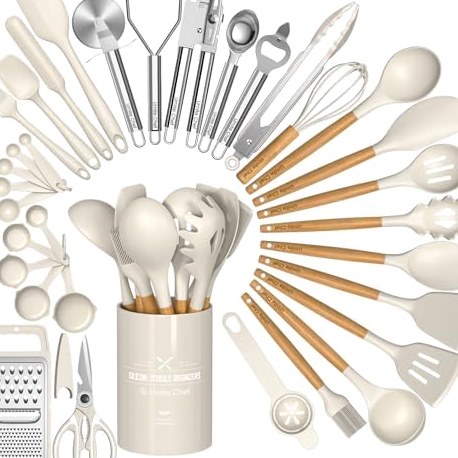
The label costs nothing to print; the chemistry behind it doesn’t. FDA standards, filler impostors, the temperature question, and a five-minute audit for your own drawer.