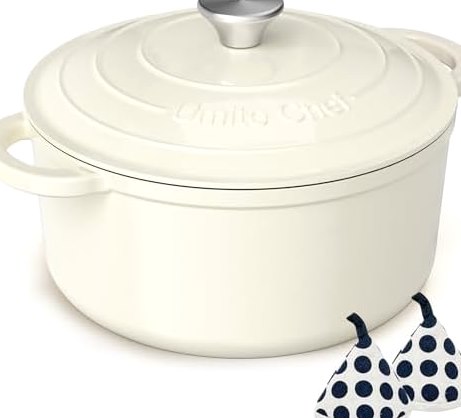
Care Guides
Enameled Cast Iron: the Myth-Free Care Guide
No seasoning, soap is fine, and only one real enemy: the complete care manual for a dutch oven that should outlive its warranty by decades.

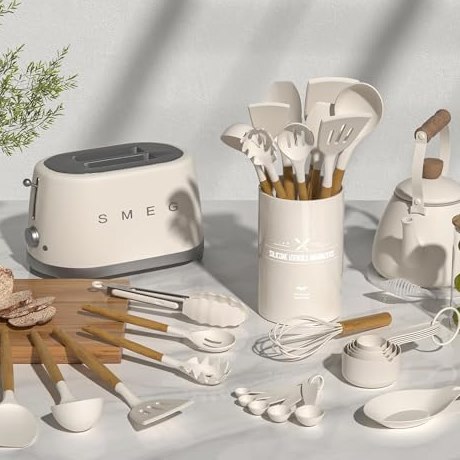
Pick up a silicone spatula in a store and it tells you almost nothing: they all look soft, they all claim heat resistance, and they all cost within a few dollars of each other. The differences that decide whether a tool survives three years of daily cooking or folds, literally, within a month are all invisible, made months earlier in a factory. Here's the full journey of a Umite Chef tool from raw polymer to your utensil crock, and where cheap tools quietly cut the corners you can't see.
Silicone isn't plastic, though it gets shelved with it. Plastics are carbon-chain polymers; silicone is built on a silicon–oxygen backbone, the same chemistry family as quartz. That backbone is why the material shrugs off temperatures that melt kitchen plastics: the bonds holding it together are simply stronger than the heat energy a frying pan can throw at them. It's also why properly made silicone is inert: it doesn't react with acidic tomato sauce, doesn't hold onto curry oils, and doesn't release anything into food across its working range.
The catch is the phrase properly made. Raw silicone rubber arrives at a factory as a gum, and everything that matters happens in how it's compounded, cured and finished. Two spatulas can look identical while one is 100% food-grade silicone over a steel core and the other is a thin silicone skin over a filler blend that starts breaking down at oven temperatures. The label rarely tells you which one you're holding — the process does.
Food-grade silicone starts with high-purity polysiloxane gum mixed with reinforcing silica, and, critically, nothing else that has business near food. Cheap compounders stretch expensive silicone with mineral fillers to cut cost. The test is embarrassingly simple: pinch and twist a cheap silicone head hard and white stress-marks bloom where filler particles separate from the polymer. Twist a pure-silicone head and it returns to color like nothing happened. That pinch test at goods-in is one of the first checks our production partners run on every material batch.
Pigments matter just as much, because color is where non-food chemistry most often sneaks in. Every colorway across our range, the khaki, the cream, the black that ties utensil sets to mixing bowls, uses food-contact-rated pigment masterbatch, compounded before curing so the color runs through the material rather than sitting on it. That's why a scratched Umite Chef tool shows the same color underneath: there's no coating to scratch off.
Here's the engineering decision that separates tools that work from tools that flex: what's inside the head and neck. Molding solid silicone alone gives you a tool with the rigidity of a thick gummy bear: fine for scraping a bowl, useless under a full pancake. The fix is insert molding: a one-piece stainless steel core is placed into the mold, and silicone is formed around it in a single shot.
The words one-piece carry the weight in that sentence. Budget tools that advertise a core often use a short steel stub that ends where the head begins: the tool still folds at exactly the point of maximum load. In our spatulas and turners the core runs continuously from handle joint through the working head. Hence a 33-piece set tool can lift a seared chicken thigh without the head deflecting. It also closes the hygiene gap: with head and core molded as one sealed unit, there's no seam where dishwater collects and no joint to loosen.
| Construction | How it behaves | How long it lasts |
|---|---|---|
| Hollow molded silicone | Folds under load; fine for scraping only | 1–2 years before flex cracks |
| Short core stub | Feels stiff in the store, folds at the neck in the pan | Joint loosens; water ingress |
| One-piece steel core (ours) | Rigid through the full length; transfers real force | Years: the silicone outlives the pans |
The compounded silicone is formed in heated compression or injection molds, then cured, vulcanized, so the polymer chains crosslink into their final elastic network. Proper curing is a time-and-temperature discipline, and it's followed by a step budget factories love to skip: post-curing, a second bake in ovens at around 390°F for several hours. Post-curing drives off volatile residues left from the curing catalysts.
You already know which tools skipped it. That rubbery chemical smell some silicone products carry, the one that transfers a faint taste to the first pancakes, is the smell of volatiles that should have been baked out at the factory. Fully post-cured silicone smells like nothing, which is the entire point of an inert material. If a tool arrives smelling of anything, that's not "newness"; that's an incomplete process.
An inert material should be boring: no smell, no taste, no reaction. Every interesting thing cheap silicone does is a defect.
The head does the cooking; the handle decides whether you enjoy it. We build three ways, and each has its own line at the factory. 18/8 stainless handles — on the 15-piece and 43-piece sets, are polished tube steel, capped and sealed so the dishwasher can't get inside. Acacia handles on the 8-piece set are cut from kiln-dried hardwood, shaped, then finished with food-safe oil rather than lacquer. It is why they age like a cutting board instead of peeling like furniture. Anti-scald wood on the wooden-handled sets is selected for low heat conduction. You can leave the spoon against the pot longer than you should and pick it up without the theatrical hiss.
Every handle type gets the same pull-test at assembly: head and handle are loaded against each other beyond any realistic kitchen force. A tool that will ever separate does it there, on the line: not over your Sunday sauce.
Finished tools are batch-tested against the numbers on our packaging, which is what makes them numbers instead of adjectives. Heat testing holds samples at 446°F to confirm no deformation, stickiness or odor release. Migration testing, the food-safety one, soaks tools in food-simulating solvents and measures what, if anything, transfers; passing is how a batch earns the right to be called food-grade. Load testing flexes turners through thousands of cycles at the neck. Dishwasher simulation runs steel-handled tools through weeks' worth of hot cycles in days.
None of this is exotic. It's just done: every production run, not once for a certificate photo. It's also why we can put a 12-month guarantee on tools that cost a fraction of the boutique brands: the failure modes have already been hunted down at the factory, in the only place they're cheap to fix.
Here's an industry open secret: almost no kitchenware brand, at any price, owns the factory that makes its silicone tools. The entire market, from marketplace no-names to the boutique brands charging $18 per spatula — runs on contract manufacturing, mostly in a handful of industrial clusters that have spent twenty years getting very good at exactly this. The difference between brands isn't who owns the machines; it's the specification they hand the factory and the checks they pay for afterward.
A specification is a stack of decisions the buyer either makes or defaults on: virgin silicone or "commercial grade"? Post-cure hours or straight to packing? One-piece core or the short stub that reads the same on a listing? Batch migration testing or a two-year-old certificate photocopied onto every carton? Every one of those is a line item with a price, and the brands that skip them are not lying, exactly: they're just not asking. The factory builds precisely what's ordered.
That's why our relationship with production partners looks less like shopping and more like auditing. The spec sheet locks material grades and process steps; goods-in testing at the factory catches material substitution before it's molded; and third-party batch tests confirm the finished run matches the paper. It's unglamorous work that adds cents per tool, and it's the entire difference between the two identical-looking spatulas from the beginning of this article. When a brand can tell you why its tool costs what it costs, step by step, that's the tell you're holding the better one.
Every silicone tool is built to a specification. The only question is whether anyone was holding the factory to it.
The utensil drawer has been through three material revolutions. Metal ruled while cookware was bare iron and steel: indestructible tools for indestructible pans. Then nonstick coatings arrived in the 1960s, and suddenly the indestructible tool was the destroyer — a steel turner could end a coated pan in one enthusiastic weekend. The market answered with nylon and other kitchen plastics: pan-safe, cheap, and fundamentally miscast for the job. Nylon starts softening near 400°F, which is below searing temperature; every household has owned the melted-edge nylon turner that proves it.
Silicone won the third era because it was the first material that didn't have to choose between the pan and the heat. Soft enough for any coating, stable past every stovetop temperature short of open flame, and inert in ways nylon never managed: no white bloom after the dishwasher, no cracking at the handle, no mystery smell in the drawer. The remaining weakness, floppiness under load, is a geometry problem rather than a material one, and the steel core solved it. What's left is a tool that borrows metal's spine, plastic's pan manners, and glass's chemistry.
The honest postscript: metal never actually left, and shouldn't. On bare cast iron and stainless, surfaces with nothing to scratch, a steel fish spatula is still the right blade, which is exactly the division of labor laid out in the materials comparison on our home page. Silicone didn't conquer the whole kitchen. It conquered the coated cookware kitchen, which happens to be most of them.
Five questions turn any listing or box into a confession. What exact temperature is the rating? A number means a test; "heat resistant" means a hope. Is the core one-piece, and how far does it run? "Steel core" without "one-piece" usually means the stub. Which food-contact standard was tested, FDA 177.2600, LFGB, either? Naming the standard is the difference between compliance and vocabulary. Is the color throughout or coated? Scratch-tests answer this in stores; honest brands answer it in the listing. What does the warranty actually cover, for how long? A brand that expects its tools to fail prices that into a vague guarantee; a brand that has watched its failure-rate data can afford to print "12 months" and mean it. Any listing that answers all five plainly, ours or a competitor's, is almost certainly selling the properly made version, because manufacturers who do the work love talking about it, and manufacturers who don't, don't.
One more habit worth stealing from professional buyers: keep the box insert or listing screenshot of whatever you purchase. When a tool outperforms or underperforms two years later, that record tells you which spec produced the result, and turns your next purchase from a guess into a repeat order or a course correction.
You can't see compounding, curing or core construction through shrink-wrap. But you can use the proxies: pinch-twist for filler, smell for post-curing, neck-flex for the core, and a brand willing to print actual numbers, 446°F, −22°F, 18/8, BPA-free, instead of "premium quality." That's the checklist we built our own range to pass, and it applies in any store, whatever you end up buying. See how the finished tools handle a real kitchen in the utensil collection, or start with the materials themselves in our plain-English guide to food-grade silicone.
No seasoning, soap is fine, and only one real enemy: the complete care manual for a dutch oven that should outlive its warranty by decades.
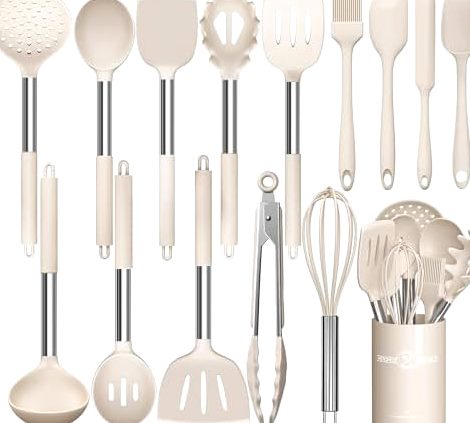
Every set size claims to be the right one. It can’t be. What each tier actually contains, who genuinely needs it, and four questions that pick your box in a minute.
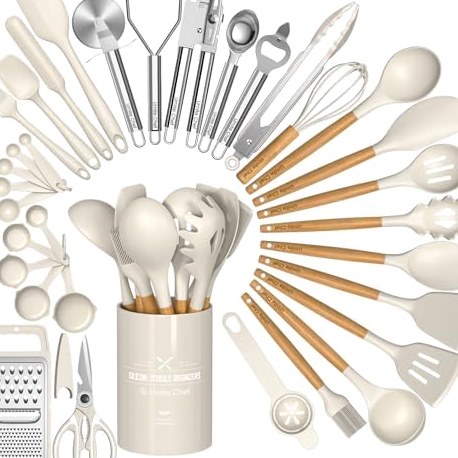
The label costs nothing to print; the chemistry behind it doesn’t. FDA standards, filler impostors, the temperature question, and a five-minute audit for your own drawer.